EN
EN DE
DE Italiano
 Español
 Français
 Português
 Nederlands
 Dansk
Dansk Polski
 český
český Norge
Norge Svenska
 Türkçe
 しろうと
しろうと بالعربية
  Tiếng Việt
 한국어
한국어 Русский язык
 คนไทย
คนไทย Indonesia
How to Choose the Right Panel PC for Ships, Marine Equipment, Coastal Facilities, and Other Marine Environments
To choose a suitable panel PC:
the first step is to clearly understand the installation location and environmental conditions of your device. Next, you need to identify the wide range of panel PCs available on the market for different industries. Finally, combine these two factors to purchase an all-in-one panel PC that meets your specific requirements.
This can help ensure that your device operates reliably for a long time and avoid the losses caused by purchasing an panel PC that does not meet your actual requirements.
Panel PCs used on ships, in marine equipment, and at coastal facilities face a common factor: seawater.
The ocean is an extremely complex corrosive environment. In this environment, seawater itself is a highly corrosive medium. At the same time, waves, tides, currents, temperature, and sunlight repeatedly affect components and products made of metal, plastic, and rubber, accelerating corrosion and aging. In addition, the ocean contains a large number of microorganisms that can directly or indirectly accelerate the rate of corrosion.
Based on the rate and severity of corrosion, marine environments can be roughly divided into the marine atmospheric zone, seawater splash zone, and fully immersed seawater zone.
The seawater splash zone is the area affected by the greatest number of factors and has the highest corrosion rate. Coincidentally, this is also the area where panel PCs are often installed and used on ships, in marine equipment, and at coastal facilities. Therefore, choosing a suitable all-in-one panel PC requires even more time and attention to understand the actual environmental requirements.
Panel PCs are widely used and continue to develop in modern society.
As the requirements and characteristics of different industries vary, different types of panel PCs have been developed to meet the needs of different industries.
* By function, they can be divided into communications, monitoring, vehicles, ships, aviation, and mining applications.
* By installation location, they can be divided into indoor, outdoor, and marine applications.
* By industry, they can be divided into commercial, industrial, medical, and military applications.
To help everyone better understand the characteristics of different Panel PCs, two real-world application examples from our customers are provided below:
| No. | Category | Automation Panel PC | Marine Panel PC | Remark |
| 1 | Application | Textile Factory Production Workshop | Offshore Construction Vessel | Indoor and offshore applications, respectively. |
| 2 | Operation | Controls an automated production line. | Used to control the operation of wire rope equipment. | Common operation |
| 3 | Size & Performance | 15”Touch Panel PC | 15”Touch Panel PC | Same Display Size |
| 4 | Protection Rating | Front IP65, fanless, and dustproof. | Full IP66, fanless, corrosion-resistant, dustproof, waterproof, and moisture-resistant. | Different applications require different levels of protection. |
| 5 | Material | Aluminum panel, steel enclosure, and aluminum alloy heat dissipation. | 316L stainless steel panel and enclosure, with corrosion-resistant treatment for the aluminum alloy heat dissipation structure. | Different protection levels require different materials. |
| 6 | I/O Ports | 2 x LAN ports, 6 x DB9 serial ports, and 4 USB ports. | The LAN, serial port, and USB ports use waterproof connectors rated IP67 or above. | The port layout and connectors are different. |
| 7 | Display Performance | 350 nits brightness, full viewing angle. | 1000 nits brightness, full viewing angle, with automatic brightness adjustment and anti-glare. | The specifications of the selected LCD components are different, and the manufacturing processes are also different. |
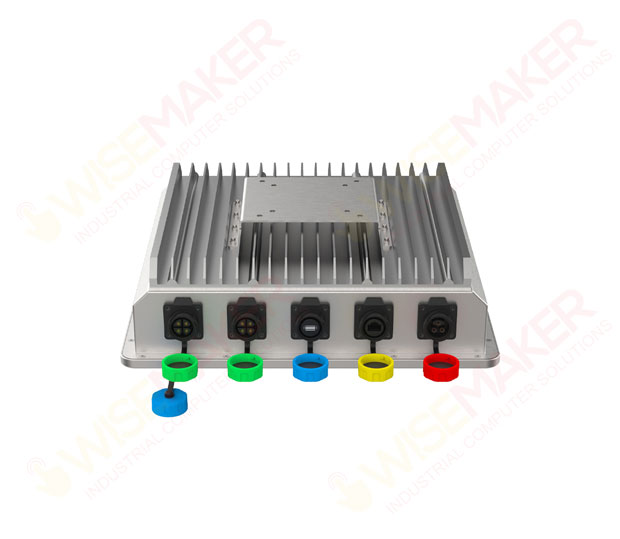
Wisemaker Automation Panel PC : Wisemaker Marine Panel PC :
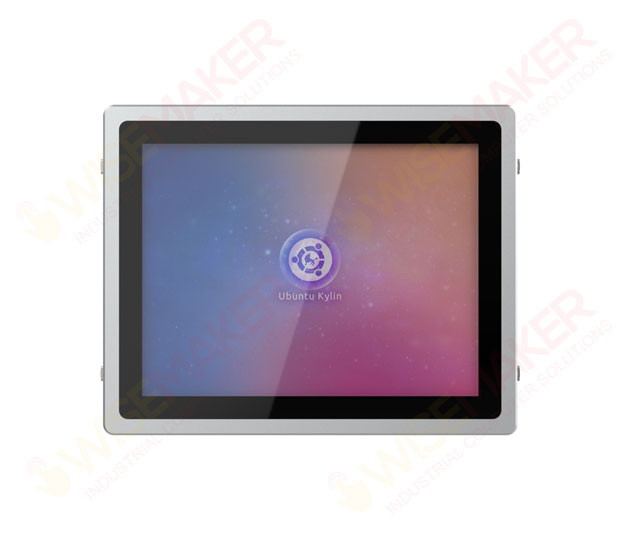
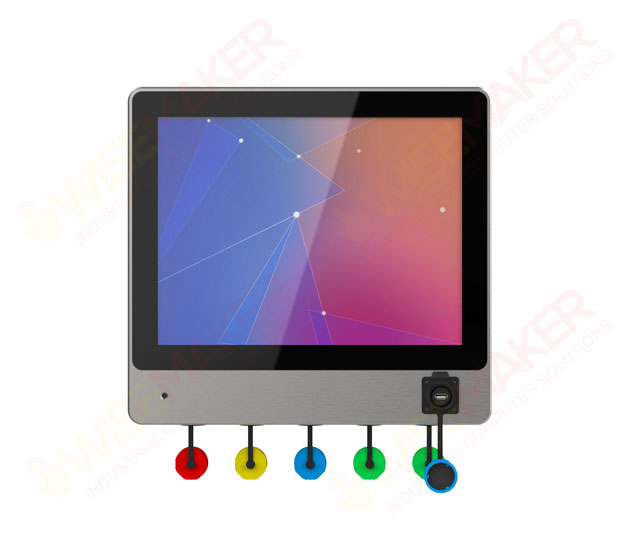
From the simple comparison in the table above, it can be seen that panel PCs for different industries and applications are completely different in terms of design, materials, manufacturing, use, and requirements.
Next, we will discuss the characteristics and considerations of panel PCs used on ships, in marine equipment, and at coastal facilities, covering all aspects from design to use.
First, we need to identify the application environment and how the panel PC will be used. Simply put: where will it be used, and how will it be used? This determines the direction we should take and which factors we need to focus on.
Second, we need to consider the selection of materials, component procurement, processing technology, assembly, and testing. By considering these four aspects together, we can produce an panel PC with a good balance between performance and cost. This determines how attractive the product is and whether it has a competitive advantage.
Finally, production, assembly, testing, and other processes are carried out according to the designed solution. Production follow-up, incoming material inspection, assembly, and testing must all be properly managed.
Let's use Wisemaker marine panel PC case from the table above to analyze this process:
1. Application Environment and Usage: A construction vessel used to build offshore facilities. The panel PC is used to control the operation of the cable equipment on the vessel.
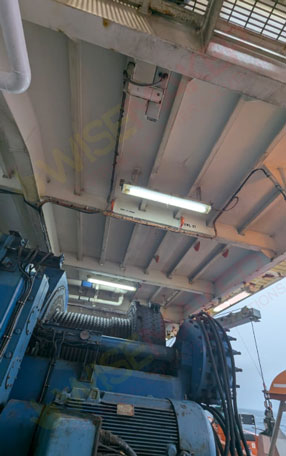
This provides us with a lot of important information: the operating environment is a seawater splash zone, which is the area with the most complex and fastest corrosion; the ambient brightness and temperature change with time and sunlight; when it rains and the wind blows, seawater may splash onto the device; industrial communication interfaces are required between the cable equipment and the panel PC; and offshore facilities inevitably have to withstand the impact of waves.
2. Materials and Manufacturing Processes: Consider the corrosion resistance, waterproofing, dustproofing, heat dissipation at high and low temperatures, and brightness adjustment of the entire unit.
2.1. The main material is 316L stainless steel. 316L stainless steel has a low carbon content and a relatively high molybdenum content. Therefore, its surface protective film is more stable, giving it strong resistance to chloride ions in seawater as well as acid and alkali corrosion.
In comparison, ordinary cold-rolled steel sheets or 304 stainless steel have a higher carbon content and lower molybdenum content. Their surface protective film is less stable, resulting in weaker corrosion resistance.
Duplex 2205 stainless steel is also a very good material for resisting seawater corrosion. However, it is currently not widely available on the market and is very expensive. Its unit price is several times higher than that of 316L stainless steel. Considering cost-effectiveness, it is not our first choice of material.
2.2. The heat dissipation material is 6063 aluminum alloy, which undergoes micro-arc oxidation treatment. When comparing the thermal conductivity and prices of copper, iron, aluminum, and stainless steel, the thermal conductivity of aluminum alloy is lower than that of copper but higher than that of iron and stainless steel, while its unit price is only about one-quarter that of copper. Therefore, 6063 aluminum alloy remains the optimal material for heat dissipation.
However, the natural aluminum oxide film on 6063 aluminum alloy has relatively low corrosion resistance and performs poorly against seawater corrosion. Therefore, aluminum alloys are generally subjected to surface oxidation treatment to improve their corrosion resistance.
Obviously, conventional anodizing and hard anodizing cannot withstand the highly corrosive conditions of seawater. Therefore, Wisemaker considered a surface treatment with higher corrosion resistance: micro-arc oxidation.
Micro-arc oxidation is a technology that uses high-voltage electrical energy to generate arc discharges on the surface of the workpiece, directly forming a ceramic layer on the original surface of the aluminum alloy. This ceramic layer has strong adhesion and excellent corrosion resistance, while also improving the surface hardness and wear resistance. However, the cost of micro-arc oxidation is more than ten times higher than that of conventional oxidation treatment.
Considering both heat dissipation performance and surface treatment, 6063 aluminum alloy with micro-arc oxidation surface treatment is the most suitable heat dissipation solution for us.
2.3. The touchscreen cover is made of tempered glass with an AG (anti-glare) treatment on the surface. During the bonding process with the functional layer, an optical bonding process with UV-resistant properties is added.
Conventional touchscreens typically use 1.1 mm or 1.8 mm tempered glass as the cover glass. However, ships are exposed to waves and strong winds, and the screen surface may frequently be subjected to strong impacts. Therefore, Wisemaker selected 3 mm thick tempered glass as the touchscreen cover glass.
The sunlight is very strong during the daytime. When it shines onto the surface of the touchscreen, the sunlight may be reflected, seriously affecting the operator's view. Therefore, Wisemaker add an AG treatment process to the surface of the cover glass.
The AG treatment creates a frosted surface on the cover glass. Because the surface after AG treatment has very fine unevenness, when sunlight shines onto the surface of the cover glass, it creates a diffuse reflection effect, allowing the operator to clearly see the content on the screen.
When the LCD screen is exposed to sunlight, ultraviolet (UV) radiation can accelerate the aging of the LCD and shorten its service life. Therefore, to reduce the damage caused by UV radiation to the LCD, we add a UV-resistant OCA layer. The UV blocking rate of this OCA exceeds 99%, effectively blocking the penetration of ultraviolet rays and extending the service life of the LCD.
2.4. The LCD uses a 1000-nit high-brightness wide-temperature-range panel and is fully optically bonded to the touchscreen.
To ensure normal operation in the high-temperature and high-brightness conditions of the marine environment and allow users to clearly see the screen content, we use a 1000-nit, full-viewing-angle LCD with an operating temperature range of -30°C to +80°C. Combined with an automatic brightness adjustment module, the screen can automatically increase its brightness under strong sunlight and automatically reduce its brightness when the ambient light is low at night.
In the marine environment, conventional LCD installation methods may allow moisture to enter the panel PC when exposed to heavy rain, strong winds, waves, and seawater splashes. If moisture enters the space between the LCD and the touchscreen, the heat generated when the screen is operating can cause the moisture to evaporate and adhere to the touchscreen, forming a white fog-like appearance and seriously affecting the display image.
Therefore, an optical bonding process is added between the LCD and the touchscreen. Optical adhesive is filled between the two layers, which not only effectively prevents air, dust, and moisture from entering, but also improves the impact resistance of the LCD. This is a very important step.
2.5. All connectors use PBT engineering-plastic waterproof plugs.
To achieve the IP66/IP67 waterproofing requirements for the entire unit, the connectors are also a key part of the design. Waterproof connectors are generally divided into two types: metal connectors and plastic connectors.
Metal connectors are commonly made of copper, zinc, or aluminum alloy, while plastic connectors are commonly made of PA6, PA66, or PBT. Considering the characteristics of these materials and their application in the marine environment, the copper, zinc, and aluminum alloys commonly used in metal waterproof connectors are all susceptible to seawater corrosion.
PA6/PA66 plastic materials can absorb moisture, which may reduce their strength. They also have a risk of salt-spray corrosion, and long-term exposure to ultraviolet radiation can easily cause carbonization.
Therefore, PBT engineering plastic is our optimal choice. PBT itself has excellent chemical corrosion resistance, low moisture absorption, and good salt-spray resistance. Its molecular structure provides relatively good resistance to chloride-ion attack, making it suitable as the housing material for waterproof connectors used in marine environments.
2.6. In addition to the five key processes described above, other detailed work must not be overlooked. For example, the selection and assembly of screws, the material and structure of sealing gaskets, the selection and application of adhesives, as well as the different requirements for the CPU, power supply, RAM memory, SSD storage , and other components. Wisemaker will not describe each of these aspects in detail here.
3. Based on the above analysis, Wisemaker first complete the design of the solution, then prepare the engineering drawings, process the components, and procure the components.
3.1. Now, let's take a look at the completed solution design.
The entire front panel of the Panel PC is made of 316L stainless steel, ensuring excellent flatness and sealing performance. An automatic light sensor is installed on the front panel to directly detect the ambient brightness and automatically adjust the screen brightness accordingly.
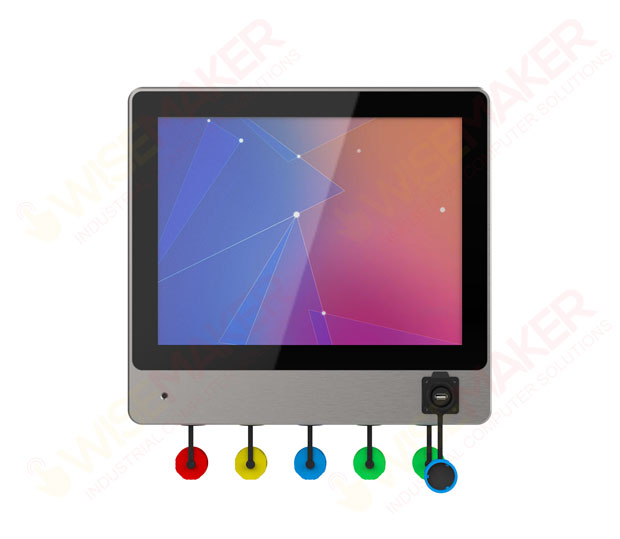
A waterproof USB connector is also integrated into the front panel, allowing users to conveniently read data or upgrade software.
The enclosure is made of 316L stainless steel and features a fully sealed welded construction with a brushed surface finish. 6063 aluminum alloy with micro-arc oxidation treatment is used as the natural heat dissipation solution for the panel PC. The wide spacing between the cooling fins helps improve airflow and heat dissipation while reducing the accumulation of salt deposits.
The unit uses standard VESA mounting holes, making installation simple and convenient.
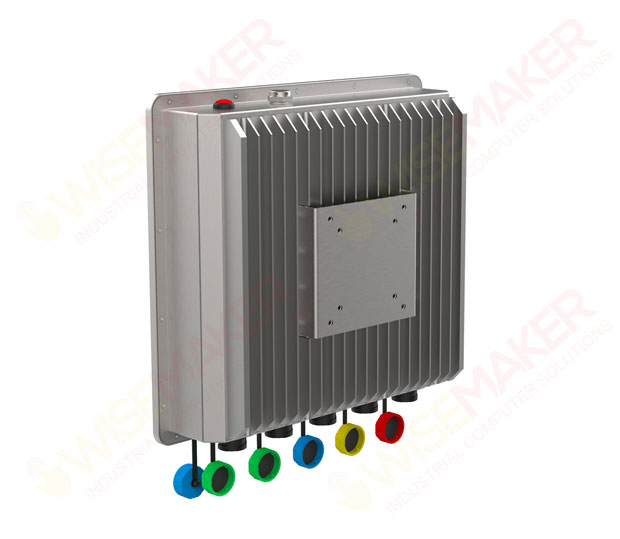
A waterproof power switch and an air vent valve are installed on the top of the unit. Placing the power switch on the top makes it easy to operate and helps prevent confusion with the connectors on the bottom. The air vent valve automatically balances the internal and external air pressure while also providing waterproof and moisture-resistant protection.
The bottom panel contains waterproof connectors for DC power, USB, LAN, and serial ports. Different-colored waterproof caps are provided, allowing installers and operators to quickly identify the different connectors.